


LATEST UPDATES ON VIETNAM'S BANK MERGER TRENDS 2025
Bank mergers are becoming a focal point in Vietnams financial system restructuring strategy for the 2025 period. Faced with capital-raising requirements under Basel III, intensifying technology competition and pressure to resolve bad debt, bank M&A deals are no longer optional but an inevitable direction. However, behind the opportunity to expand scale and boost competitiveness lies a host of risks related to valuation, legal compliance and operational systems. The article below offers an expert, in-depth and up-to-date perspective.
Why can Vietnams banking industry hardly stand still amid the M&A wave?
Vietnams banking industry is entering one of its most transformative periods in years. Pressure from international integration, the requirement to standardize governance under Basel III and the rise of digital finance models are forcing the banking system to change. Against this backdrop, mergers have become a "strategic shortcut" that helps credit institutions strengthen their capital base, modernize technology, expand their networks and improve competitiveness.
In addition, the system restructuring roadmap directed by the Government and the State Bank of Vietnam is entering an accelerated phase. Weak banks or those facing liquidity shortfalls or high bad-debt ratios, cannot sustain independent operations and are compelled to seek merger partners to help stabilize the system.
Opening the door wider to foreign investors - including proposals to raise ownership caps at certain banks following restructuring - is also fueling a new wave of M&A. In this context, standing still means losing market share, opportunities and long-term competitive advantage. These conditions are making M&A an inevitable trend for the banking sector.
Five clear signals driving the new era of bank M&A
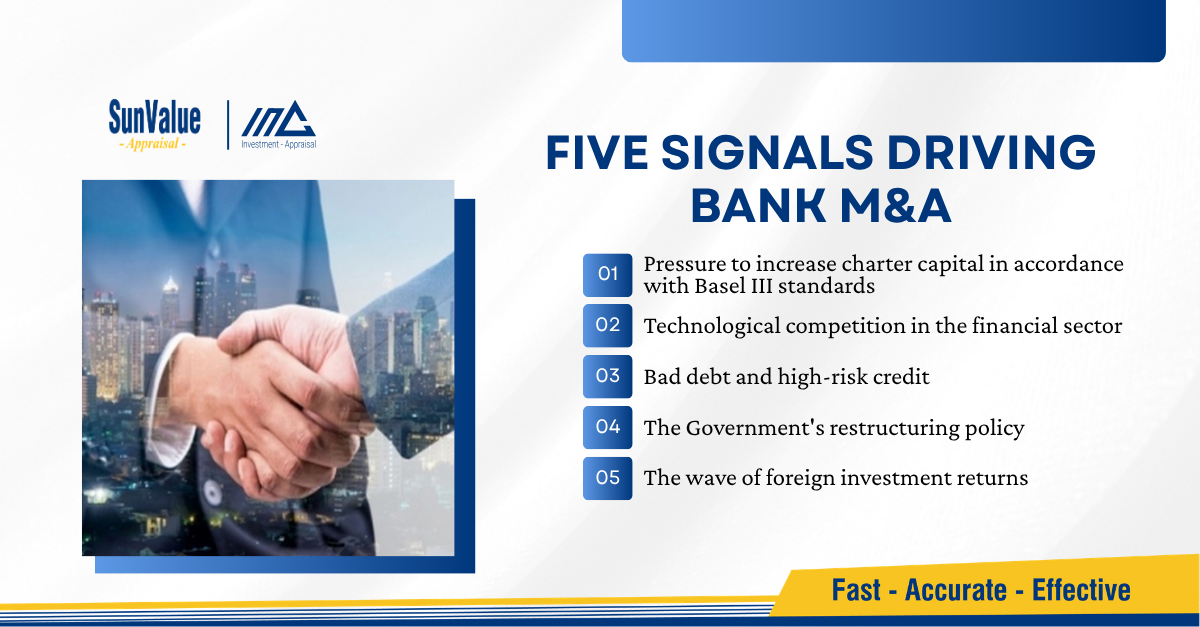
First, the requirement to increase core capital under Basel III is putting significant pressure on many banks. The new standards demand higher capital adequacy ratios, stronger risk-provisioning capacity and more effective governance processes. Banks unable to raise capital internally are forced to consider mergers.
Second, technology competition in the financial sector is accelerating. The growth of fintech, big tech and digital banking is reshaping user behavior. Smaller banks struggle to keep pace with the technology investment required, making M&A the fastest path to accessing modern platforms.
Third, bad debt and credit risk remain a persistent "bottleneck" for many credit institutions. Mergers help transfer assets, boost liquidity and create a stronger risk-management model.
Fourth, the Governments restructuring policy is encouraging consolidation to stabilize the system and strengthen the financial health of the banking sector.
Finally, the resurgence of foreign investment after the pandemic - particularly from Japan, South Korea and the EU - is opening up opportunities to mobilize substantial resources through M&A.
Strategic benefits of bank mergers: More than just capital
Bank M&A delivers benefits that go well beyond the goal of raising capital. The first is the ability to expand market scale. When two banks combine, their branch networks, customer base and market share increase significantly, strengthening competitive advantage and brand reach.
Second, mergers help optimize costs by consolidating operating systems, personnel, technology and internal processes. Eliminating redundant departments can help banks cut management costs and improve business efficiency.
Third, post-merger banks gain access to advanced technology, large databases and modern governance practices from their partners - an especially critical advantage in the era of digital banking.
Finally, a successful deal can enhance reputation, open access to international capital-raising and attract strategic investors.
Unknowns behind the M&A door: Risks you need to know
Despite the significant potential, bank mergers also carry a host of hidden risks. One of the biggest is bad debt. If the bank being merged holds hard-to-recover loans or collateral of questionable transparency, the acquiring party may suffer substantial losses.
The second risk is valuation risk. Banks are a complex type of enterprise, with diverse asset structures spanning credit, real estate, valuable papers and customer data. Mispricing can cause the entire deal to fail or create financial imbalance.
Another risk lies in technology systems. Integrating two different core banking platforms always carries the risk of data loss, operational errors or service disruption.
Corporate culture risk is also common. Without a clear personnel-integration strategy, clashing management styles can trigger internal conflict and undermine post-merger effectiveness.
Finally, there is legal risk. Approval procedures, information disclosure and regulatory compliance must all be executed precisely to avoid delaying the deal.
Effective bank M&A: A comprehensive integration model from operations to culture
A bank M&A deal only truly succeeds when it creates a complete integration model spanning operating systems, technology, finance and organizational culture. This requires careful planning starting from the pre-negotiation stage.
First, the two banks need to build a scientific data-consolidation strategy. Customer data, credit records and transaction histories must be reviewed, cleaned and standardized before migration to the new system.
Next, the governance structure needs to be redesigned appropriately to avoid overlapping functions and to optimize performance.
Equally important is the corporate-culture integration strategy. Employees need to be clearly informed about the new goals, direction and their role within the merged organization. This helps ease concerns, boost motivation and build cohesion.
On the technology side, a synchronized core-banking strategy is needed to ensure scalability, security and support for digital banking. A successful integration model allows the bank to fully capture the benefits of the merger and grow sustainably.
Indochina International Appraisal – A comprehensive bank valuation solution for every M&A deal
In bank M&A deals, numbers alone are never enough. What the market needs is the truth behind the numbers: the quality of the credit portfolio, the level of hidden risk, collateral assets, compliance capacity and the health of core technology systems. This is why credit institutions, foreign investors and financial funds all prioritize independent valuation providers to ensure objectivity, transparency and the elimination of conflicts of interest at every stage of negotiation.

With its ecosystem of in-depth appraisal services, Indochina International Appraisal offers a comprehensive suite of bank valuation solutions, including:
-
Bank enterprise valuation using internationally standardized models.
-
Credit portfolio valuation, including recoverability analysis and quality-deterioration risk assessment.
-
Valuation of collateral assets across the entire loan portfolio.
-
Bad debt and risk-structure appraisal, assessing expected credit losses (ECL) under IFRS/Basel.
-
Technology, operations and risk-governance assessment, determining integration costs for the merger.
-
Legal-compliance appraisal, helping the deal meet State Bank of Vietnam (SBV) approval requirements.
-
Technical advisory during M&A negotiations, protecting maximum interests for either the buyer or seller.
Beyond valuation itself, Indochine International Appraisal also delivers strategic advantages to clients: in-depth reports that can be used directly in negotiations, submitted to the SBV for approval and used as legal grounds when finalizing the transaction. A team of banking and finance experts well-versed in Basel III, IFRS, capital adequacy ratios, risk structures and Vietnamese legal regulations ensures comprehensive risk control throughout every deal.
Indochina International Appraisal is committed to accompanying commercial banks, credit institutions, investment funds and financial groups through large-scale M&A transactions - helping optimize deal value, reduce risk, accelerate approval and enhance competitive advantage. Contact us today for prompt consultation!
Indochina International Investment & Appraisal JSC (SunValue)
Hotline/Zalo: 081 519 8877
Email: contact@sunvalue.vn
Website: inavn.vn
Conclusion
Bank mergers will continue to be a dominant trend during the 2025–2030 period, as Vietnams financial system pushes forward with restructuring and strengthens its international competitiveness. However, major opportunities always come with complex risks - particularly around valuation, bad debt and technology. A successful M&A strategy can only begin with thorough, accurate and transparent valuation work. Choosing a reputable valuation provider is therefore a critical step in ensuring the deal proceeds safely, effectively and sustainably.
Related article
REQUEST A QUOTE
Please share with us some of your information, we will contact you upon request