


Valuing collateral assets when applying for a bank loan
When applying for a bank loan, the value of collateral is one of the key factors directly affecting the approved credit limit. However, many individuals and businesses still do not fully understand how collateral is valued, which factors influence valuation results, and how to ensure that assets are recognized at their actual market value.
Amid growing demand for financing for business operations, investment, and consumption, collateral valuation not only helps banks manage risks but also provides customers with a stronger basis for accessing funding more effectively.

What Is Collateral Valuation?
Collateral valuation is the process of determining the value of assets used as security for a loan or financial obligation at a specific point in time.
Under the 2023 Law on Prices and the current system of Vietnamese Valuation Standards, asset valuation must be based on market information, legal characteristics, the actual condition of the assets, and the purpose of valuation.
Valuation results serve as a basis for banks or credit institutions to consider:
-
Loan limits.
-
Loan-to-Value (LTV) ratios.
-
Credit approval conditions.
-
The risk level of the loan.
-
The ability to dispose of collateral in the event of debt default.
In other words, the more comprehensively and objectively an asset is valued, the easier it is for customers to access financing.
Why Is Collateral Valuation Necessary?
For Banks
Asset valuation helps banks:
-
Manage credit risks.
-
Determine appropriate loan limits.
-
Assess debt recovery prospects.
-
Comply with regulations on risk management and credit granting.
For Individuals and Businesses
Collateral valuation helps customers:
-
Understand the actual value of their assets.
-
Take a proactive approach when working with banks.
-
Increase their chances of obtaining appropriate credit limits.
-
Support refinancing or loan restructuring.
-
Provide additional evidence of their financial capacity.
-
Facilitate capital raising, M&A transactions, or bond issuance.
For businesses in particular, an independent valuation certificate often helps strengthen the credibility of credit applications.
Which Assets Do Banks Prefer to Accept as Collateral?

Although the law allows various types of assets to be used as collateral, banks do not necessarily assess all assets in the same way in practice. Credit institutions generally prioritize assets with clear legal documentation, stable values, and high liquidity.
Real Estate
This category includes:
-
Residential houses.
-
Townhouses.
-
Apartments.
-
Residential land.
-
Villas.
-
Commercial and service land.
-
Office buildings.
This is the most commonly used category of collateral due to its high value and relatively favorable transferability.
Factories and Business Operating Assets
Assets commonly considered by banks include:
-
Factories.
-
Warehouses and storage facilities.
-
Logistics centers.
-
Manufacturing facilities.
-
Assets attached to land.
Machinery and Equipment
This category includes:
-
Production lines.
-
Industrial equipment.
-
Medical equipment.
-
Energy equipment.
These assets are generally assessed based on their technical condition, age, and actual operational capacity.
Transportation Vehicles
-
Automobiles.
-
Tractor trucks.
-
Ships and watercraft.
-
Specialized vehicles.
Investment Projects and Corporate Assets
For large-scale loans, banks may consider:
-
Real estate projects.
-
Property rights arising from projects.
-
Shares.
-
Capital contributions.
-
Businesses.
How Do Banks Value Collateral Assets?
When considering credit applications, banks assess not only customers financial capacity but also the value of collateral to manage risks and determine appropriate loan limits.
Depending on the internal policies of each credit institution, collateral valuation may be conducted by an in-house valuation department or through an independent valuation company.
Legal Status of the Asset
This is one of the most important factors affecting the value of collateral.
Banks and valuation firms typically examine:
-
Certificates of land use rights and asset ownership.
-
Construction completion documents and building permits (if applicable).
-
Disputes, enforcement measures, or restrictions on transactions.
-
Planning information and land-use plans.
-
Conditions for transferring and disposing of assets under applicable laws.
Assets with complete and clear legal documentation are generally valued more favorably and are more advantageous during the credit approval process.
Asset Characteristics and Actual Condition
Asset value also depends on its actual condition at the time of valuation.
For real estate, the factors commonly considered include:
-
Location and transportation connectivity.
-
Land area and plot shape.
-
Frontage and accessibility.
-
Current condition of structures on the land.
-
Residential environment and local infrastructure.
-
Development and utilization potential.
For machinery, equipment, factories, and transportation vehicles, valuation professionals assess:
-
Year of manufacture.
-
Technical condition.
-
Remaining quality.
-
Degree of depreciation and wear.
-
Operational and utilization capacity.
-
Market liquidity.
Market Information and Data
Under Vietnamese Valuation Standards, asset value must be assessed based on relevant market information available at the time of valuation.
The data typically collected and analyzed include:
-
Actual transaction prices of comparable assets.
-
Asking prices in the market.
-
Local supply and demand conditions.
-
Economic conditions and market trends.
-
Factors affecting the marketability and transferability of assets.
Due to market fluctuations, the same asset may have different values at different points in time.
Asset Liquidity and Disposal Potential
For credit security purposes, banks pay particular attention to the transferability and disposability of assets when risks arise.
Assets with transparent transaction markets, strong demand, and high transferability are generally viewed more favorably during the credit approval process.
Valuation Results and the Banks Credit Policies
Valuation results are one of the bases banks use to determine loan limits. However, the approved loan amount is not necessarily equal to the value of the asset.
In practice, banks also take into account:
-
Internal credit policies.
-
The risk level of the loan.
-
The customers financial capacity.
-
Credit history.
-
The intended use of funds.
Therefore, collateral value and the approved loan limit are related but not identical.
Collateral Valuation Process
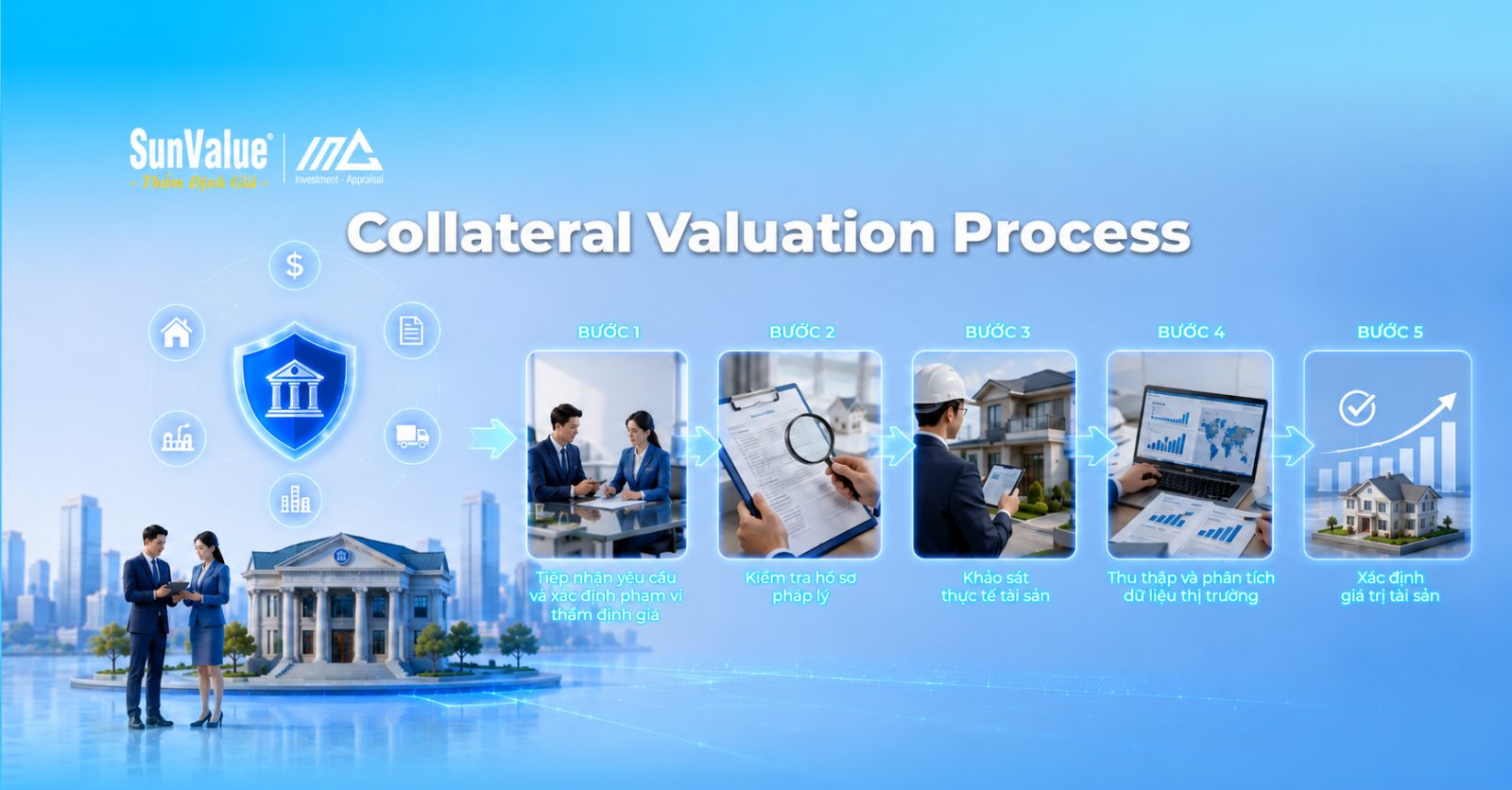
Under the Law on Prices and Vietnamese Valuation Standards, the collateral valuation process generally consists of six steps:
-
Step 1 – Receiving the Request and Defining the Scope of Valuation: Collecting information about the asset, the valuation purpose, and relevant documentation.
-
Step 2 – Reviewing Legal Documentation: Examining ownership rights, land use rights, and legal issues that may affect the assets value.
-
Step 3 – Conducting an On-Site Asset Inspection: Valuation professionals directly inspect the assets actual condition, location, scale, quality, and utilization potential.
-
Step 4 – Collecting and Analyzing Market Data: Gathering information on transaction prices, comparable assets, supply and demand, and relevant economic factors.
-
Step 5 – Determining Asset Value: Applying appropriate valuation approaches, such as:
-
Sales Comparison Approach.
-
Cost Approach.
-
Income Approach.
-
-
Step 6 – Issuing the Valuation Certificate: The results are presented in a valuation report and valuation certificate in accordance with applicable laws.
How Can You Increase the Value of Collateral Assets?
To ensure that assets are properly recognized at their actual value and improve access to financing, customers should:
-
Complete Legal Documentation:
-
Land Use Rights Certificate (Red Book) or Certificate of Land Use Rights and Ownership of Assets Attached to Land (Pink Book).
-
Construction completion documents.
-
Building permits.
-
Asset ownership documents.
-
-
Update the Actual Condition of Assets: Repair, upgrade, or complete structures to ensure that their condition accurately reflects their actual value.
-
Supplement Technical Documentation: Particularly for:
-
Factories.
-
Machinery and equipment.
-
Production lines.
-
Investment projects.
-
-
Obtain an Independent Valuation: A valuation certificate issued by a professional valuation firm provides customers with an additional basis for discussions with banks, investors, and financial partners.
Indochina International Appraisal – A Trusted Collateral Valuation Partner for Banks and Businesses

Many customers own high-value assets but still face difficulties obtaining bank loans because their assets are valued below their actual market value or their documentation does not provide sufficient supporting evidence for banks. Meanwhile, even a difference of just a few percentage points in valuation results can significantly affect the approved credit limit.
This is why an increasing number of individuals, businesses, and investors choose professional valuation services before working with banks.
With more than 24 years of experience in the valuation industry, Indochina International Appraisal provides objective, transparent, and market-oriented asset valuation solutions, helping customers strengthen their loan applications and improve the efficiency of financial resource mobilization.
Collateral Valuation Services Provided by Indochina International Appraisal
-
Valuation of townhouses, land plots, apartments, and villas.
-
Valuation of factories, warehouses, and industrial parks.
-
Valuation of machinery, equipment, and production lines.
-
Valuation of transportation vehicles and specialized assets.
-
Valuation of real estate projects and investment projects.
-
Valuation of businesses, shares, and capital contributions.
-
Valuation of assets for credit approval, refinancing, and debt restructuring purposes.
Why Do Many Customers Choose Indochina?
-
In-depth understanding of the valuation requirements of banks and credit institutions.
-
An experienced team of valuation professionals with expertise in handling complex and high-value asset portfolios.
-
A nationwide market price database that is continuously updated.
-
A fast and transparent process for inspections, analysis, and valuation certificate issuance.
-
Valuation reports supported by clear legal grounds and meeting the requirements of many banks and financial partners.
For businesses, valuation certificates not only help determine asset values but also strengthen credit applications, support capital raising, M&A transactions, loan restructuring, and bond issuance.
If you need collateral valuation for a bank loan or wish to reassess your assets to optimize your credit limit, Indochina International Appraisal is ready to accompany you and provide suitable valuation solutions.
Indochina International Appraisal & Investment JSC (SunValue)
Hotline/Zalo: 081 519 8877
Email: contact@sunvalue.vn
Website: inavn.vn
Frequently Asked Questions
-
How long is a collateral valuation certificate valid?
Its validity generally depends on the intended use and the requirements of the organization receiving the documentation. Many credit institutions require the valuation certificate to remain valid at the time the loan application is reviewed. -
Can leased assets be used as collateral?
Yes. However, the valuation firm must review the lease agreement and the rights to utilize the asset. -
Can an asset be revalued to increase the loan limit?
Yes. Many businesses reassess their assets when market prices increase or when assets have been upgraded. -
Can machinery and equipment be used as collateral?
Yes, provided that they meet legal requirements and ownership can be demonstrated. -
How much does collateral valuation cost?
The cost depends on the type and value of the asset, the scope of the inspection, and the intended use of the valuation certificate.
Conclusion
Collateral valuation is an important step that helps banks manage risks while enabling customers to optimize their access to financing. Accurate, objective, and market-based valuation results can make a significant difference in approved credit limits and capital utilization efficiency.
If you need collateral valuation for loan applications, refinancing, debt restructuring, or investment capital mobilization, Indochina International Appraisal is a reliable partner, providing transparent and professional asset valuation services in compliance with current legal regulations.
Related article
REQUEST A QUOTE
Please share with us some of your information, we will contact you upon request