


Reliable machinery and equipment appraisal services
In business and manufacturing operations, machinery and equipment often account for a significant proportion of a companys total assets. However, many businesses have yet to fully leverage the value of these assets when applying for bank loans, restructuring their finances, contributing capital to investments, or undertaking mergers and acquisitions (M&A).
Machinery and equipment Appraisal is a solution that helps determine asset values objectively, transparently, and on a sound legal basis, thereby supporting businesses in making more effective financial, investment, and management decisions.
What Is Machinery and Equipment Appraisal?
Machinery and equipment Appraisal is the process of determining the monetary value of machinery, production lines, industrial equipment, or technical assets at a specific point in time for a defined Appraisal purpose.
The Appraisal results are presented in the form of:
-
Appraisal report.
-
Appraisal certificate.
-
Inspection and market analysis documentation.
This activity is carried out by Appraisal enterprises that meet the eligibility requirements under applicable laws and Vietnamese Appraisal Standards.
When Is Machinery and Equipment Appraisal Necessary?
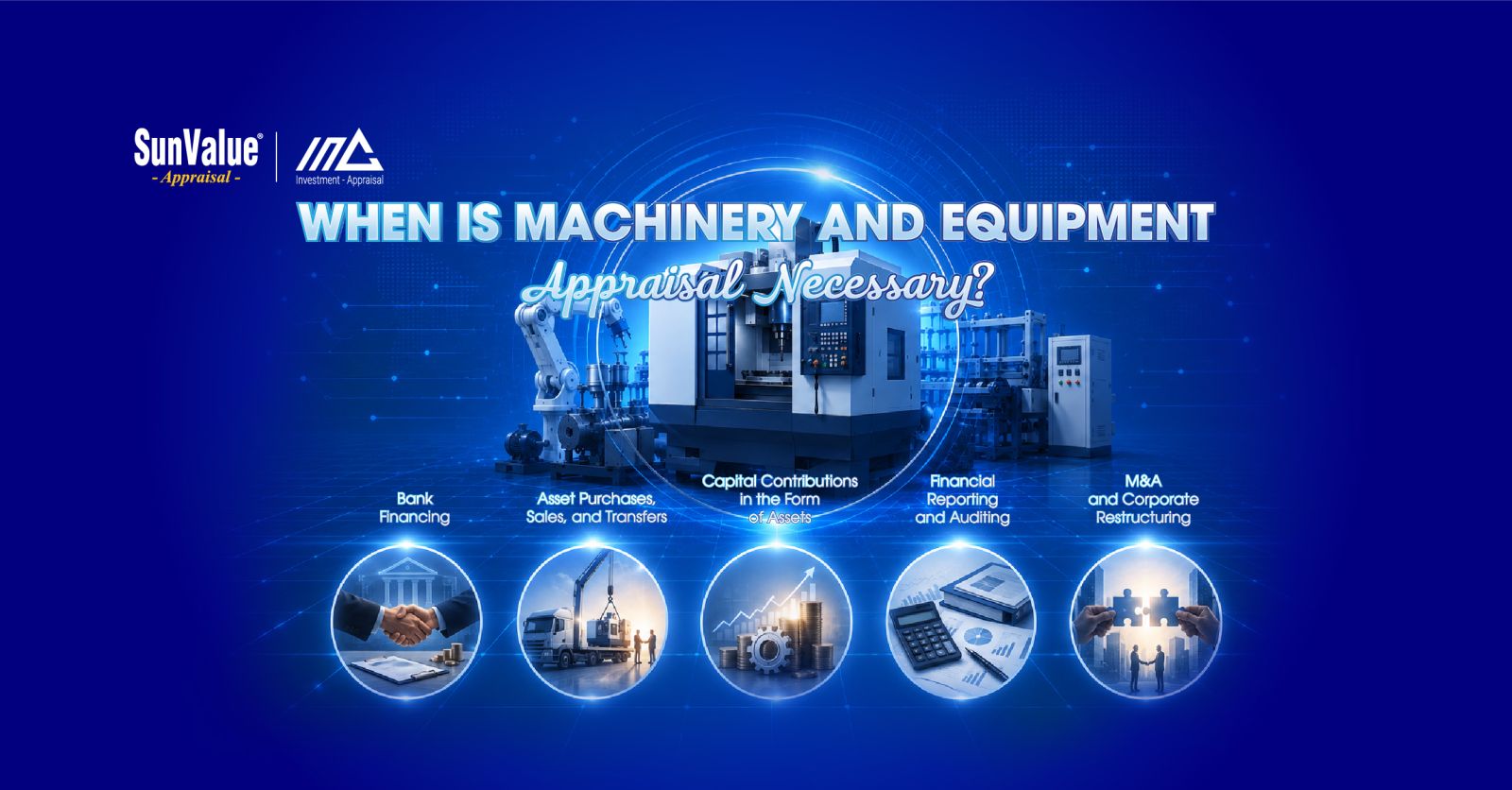
Bank Financing
Banks often require the value of collateral to be determined before granting credit.
Common assets include:
-
CNC machines.
-
Plastic injection molding machines.
-
Forklifts.
-
Production lines.
-
Mechanical equipment.
-
Construction machinery.
The Appraisal results help determine:
-
The value of mortgaged assets.
-
The loan limit.
-
The loan-to-value ratio.
Asset Purchases, Sales, and Transfers
When a business buys or sells machinery and equipment, determining the correct market value helps to:
-
Minimize the risk of inaccurate Appraisal.
-
Prevent asset losses.
-
Increase transaction transparency.
Capital Contributions in the Form of Assets
Many businesses use machinery and equipment to:
-
Establish a company.
-
Increase charter capital.
-
Participate in investment partnerships.
In these cases, the value of contributed assets should be determined objectively and supported by a legal basis.
Financial Reporting and Auditing
Businesses may need to:
-
Revalue fixed assets.
-
Determine the remaining value of equipment.
-
Review asset values during restructuring.
M&A and Corporate Restructuring
In many M&A transactions, machinery and equipment may account for a substantial proportion of a companys total value.
Appraisal helps to:
-
Determine the actual value of assets.
-
Assess investment efficiency.
-
Support negotiations over the purchase or sale price of a business.
Types of Machinery and Equipment Commonly Valued
Indochina International Appraisal regularly values the following asset groups:
Production Lines
-
Food processing.
-
Beverages.
-
Garments.
-
Packaging.
-
Wood processing.
-
Cement.
Mechanical Equipment
-
Lathes.
-
Milling machines.
-
CNC machines.
-
Laser cutting machines.
Construction Equipment
-
Excavators.
-
Bulldozers.
-
Cranes.
-
Concrete batching plants.
Logistics Equipment
-
Forklifts.
-
Warehousing and logistics systems.
-
Conveyor systems.
Medical Equipment
-
CT scanners.
-
MRI machines.
-
X-ray machines.
-
Laboratory testing systems.
Energy Equipment
-
Solar power systems.
-
Wind power systems.
-
Transformer substations.
-
Electricity transmission systems.
Types of Machinery and Equipment Commonly Accepted by Banks as Collateral
|
Asset Category |
Level of Acceptance |
|
CNC machines |
Very high |
|
Plastic injection molding machines |
Very high |
|
Food production lines |
High |
|
Wood processing machines |
High |
|
Forklifts |
High |
|
Construction machinery |
High |
|
Medical equipment |
Medium to high |
|
Solar power systems |
High |
|
Wind power systems |
High |
|
Specialized technological equipment |
Depends on the bank |
Machinery and Equipment Appraisal Methods
When valuing machinery and equipment, businesses and Appraisal firms must take into account the current Law on Prices, Vietnamese Appraisal Standards issued by the Ministry of Finance, regulations governing collateral of credit institutions, regulations on the management of public assets where relevant, and accounting and auditing standards applicable to fixed assets.
Full compliance with the legal framework helps ensure that Appraisal results are objective and transparent, and can be used in economic transactions, credit applications, financial statements, asset purchases and sales, capital contributions, or M&A.
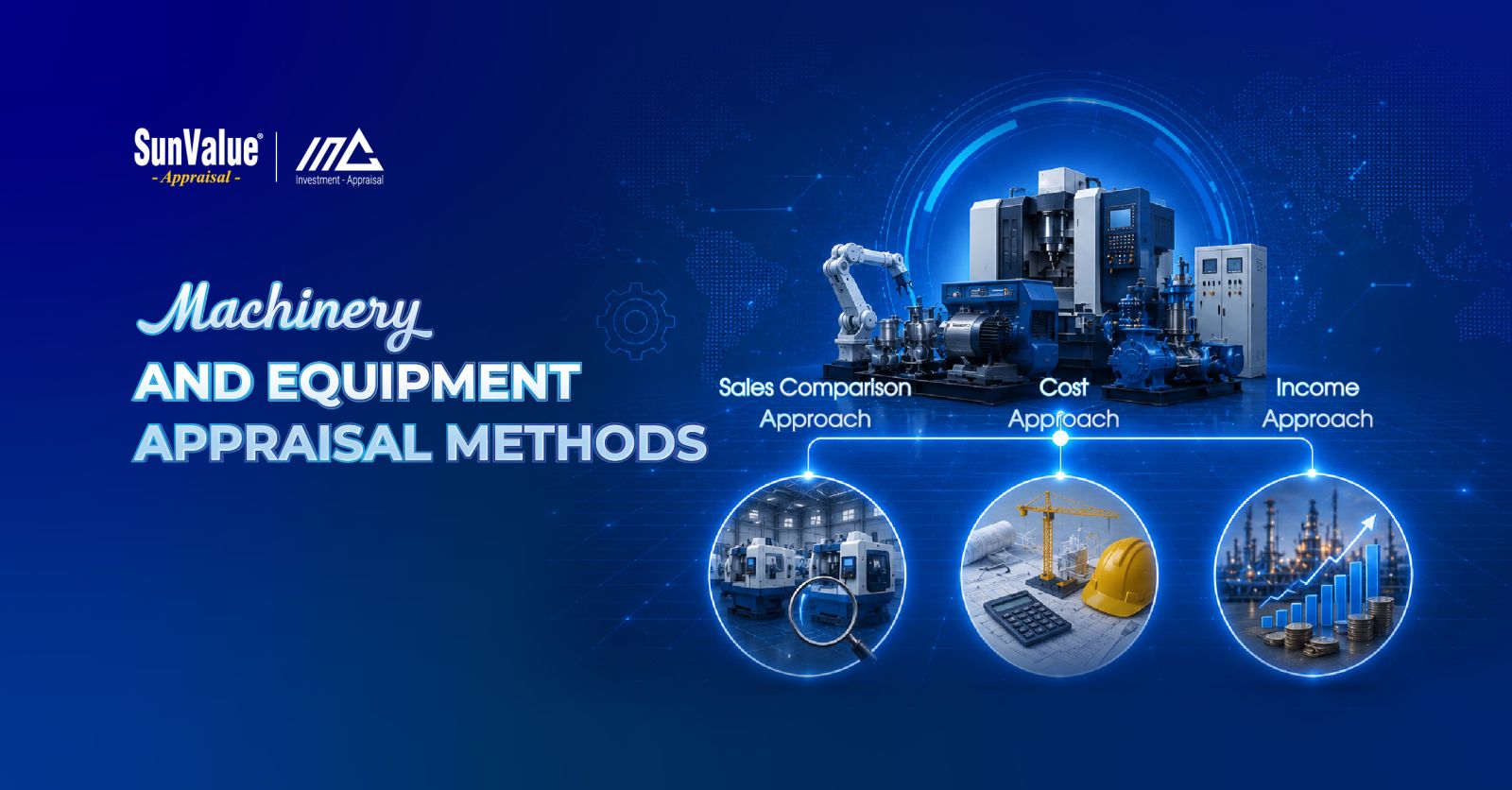
Sales Comparison Approach
The sales comparison approach is used when market data is available for similar machinery and equipment. The asset value is determined based on actual transaction prices, asking prices, supplier quotations, or market data for equipment with comparable functions, capacity, origin, year of manufacture, and condition.
This approach is suitable for common types of machinery with relatively active and transparent resale markets, such as forklifts, construction machinery, CNC machines, plastic injection molding machines, medical equipment, and certain types of commonly used production equipment.
Cost Approach
The cost approach is widely used in machinery and equipment Appraisal, particularly for specialized assets, production lines, or equipment for which direct market transaction data is limited.
Under this approach, asset value is determined based on the cost of reproducing or replacing the asset with an equivalent one, less accumulated depreciation.
Depreciation and obsolescence factors commonly considered include:
-
Physical deterioration resulting from service life, operating environment, and maintenance condition.
-
Functional obsolescence caused by outdated technology, unsuitable capacity, or declining operating efficiency.
-
Economic obsolescence resulting from market fluctuations, changes in production demand, or conditions affecting asset use.
Income Approach
The income approach is applied to machinery, equipment, or production lines capable of generating independent cash flows. The asset value is determined based on the economic benefits the asset is expected to generate in the future.
This approach is often suitable for solar and wind power systems, specialized production lines, extraction equipment, or assets that directly generate revenue for a business.
In practice, valuers may apply one method or combine several methods to arrive at the most appropriate result based on the assets characteristics, the Appraisal purpose, and market data available at the Appraisal date.
Documents Required for Machinery and Equipment Appraisal
Businesses should prepare:
-
Asset inventory.
-
Purchase and sale invoices.
-
Import contracts.
-
Payment documents.
-
Technical documentation.
-
Certificate of Origin (CO).
-
Certificate of Quality (CQ).
-
Asset photographs.
-
Maintenance and servicing records.
-
Asset depreciation records.
Preparing complete documentation can significantly shorten the Appraisal process.
Machinery and Equipment Appraisal Process at Indochina International Appraisal
-
Step 1 – Receive the Request: Collect information about the asset type, quantity, Appraisal purpose, and inspection location.
-
Step 2 – Collect Documentation: Review legal and technical documents, purchase and sale records, import documents, maintenance records, and depreciation records, where available.
-
Step 3 – Conduct an On-Site Inspection: Valuers directly inspect the operating condition, capacity, year of manufacture, degree of depreciation and deterioration, and usability of the machinery and equipment.
-
Step 4 – Analyze Market Data: Compare manufacturer quotations, import prices, transaction data, and prices of equivalent equipment in the market.
-
Step 5 – Determine Value: Apply an appropriate Appraisal method based on the assets characteristics, the Appraisal purpose, and professional standards.
-
Step 6 – Issue the Results: Provide the Appraisal report, Appraisal certificate, and supporting documentation for transactions, financing, capital contributions, audits, or M&A.
How Much Does Machinery and Equipment Appraisal Cost?
The cost depends on:
-
Asset value.
-
Number of equipment items.
-
Inspection location.
-
Complexity of the documentation.
-
Required turnaround time.
In general:
-
A single-asset engagement may be completed within 1–3 working days.
-
A production line or large-scale project may take 3–10 working days.
To receive an accurate quotation, businesses should provide an asset list and specify the Appraisal purpose at the outset.
Practical Experience from Indochina International Appraisal
Through thousands of asset Appraisal engagements for businesses, credit institutions, and investors, Indochina International Appraisal has observed that many businesses miss opportunities to realize the true value of their machinery and equipment.
Case Study 1: A Mechanical Engineering Factory Increases Its Loan Limit
A mechanical engineering company in Binh Duong owned a system of CNC machines imported from Japan.
After years of depreciation, their remaining book value was only approximately VND 12 billion.
Following an independent Appraisal, their market value was determined to be approximately VND 24 billion.
Results:
-
Increased collateral value.
-
Higher credit limit.
-
Additional capital to support production expansion.
Case Study 2: M&A of a Food Processing Factory
An investor was considering acquiring a food processing factory in the Mekong Delta.
The Appraisal found that some equipment was obsolete and that its actual value was significantly lower than the asking price.
This helped the investor to:
-
Renegotiate the transaction price.
-
Reduce investment risk.
-
Optimize transaction efficiency.
Case Study 3: Appraisal of a Solar Power System
A renewable energy company needed to determine the value of its assets for financial restructuring.
The Indochina International Appraisal team combined the cost approach and the income approach to determine an appropriate value for the entire solar power system, supporting the company in working with credit institutions and investment partners.
Indochina International Appraisal – A Professional Machinery and Equipment Appraisal Partner
Machinery and equipment represent a significant asset category for businesses, particularly in manufacturing, logistics, healthcare, energy, and industrial sectors. Determining their value accurately is not only important for asset management, but also provides a key basis for bank financing, asset-backed loans, machinery purchases, sales and disposals, capital contributions, auditing, financial reporting, M&A, and corporate restructuring.
Indochina International Appraisal provides professional machinery and equipment Appraisal services, helping businesses determine asset values objectively, transparently, and in line with actual market conditions. From individual machines and production lines to medical equipment, logistics equipment, energy systems, and entire industrial plants, the company develops Appraisal solutions tailored to the technical characteristics, operating condition, degree of depreciation and deterioration, and Appraisal purpose of each engagement.
Reasons businesses choose Indochina International Appraisal:
-
Understanding of the specific characteristics of machinery and equipment across manufacturing, industrial, healthcare, logistics, and energy sectors.
-
Experience handling engagements for bank financing, collateral, M&A, capital contributions, audits, and financial reporting.
-
Regularly updated market price data to support Appraisals that better reflect actual market conditions.
-
Clear working procedures, confidentiality, and optimized processing times.
-
Appraisal certificates prepared for their stated purposes, supporting businesses in working with banks, partners, auditors, and other relevant parties.
-
Flexible service delivery across multiple provinces and cities, suitable for businesses with factories, warehouses, or assets located at multiple sites.
With a commitment to objective, accurate Appraisals tailored to clients practical needs, Indochina International Appraisal does more than provide a Appraisal result. It also supports businesses in making effective use of their assets, improving financial transparency, and strengthening their position when working with banks, investors, partners, or auditors.
Frequently Asked Questions
-
Does a machinery and equipment Appraisal certificate have legal validity?
Yes. A Appraisal certificate issued by a Appraisal enterprise that meets the legal requirements for operation is valid for the purpose stated in the certificate. -
Can used machinery and equipment be valued?
Yes. Used machinery and equipment are among the asset categories frequently valued for bank financing, business acquisitions and sales, asset disposal, and determining the value of fixed assets. -
Can machinery and equipment be valued for a bank loan?
Yes. Many banks use Appraisal results to determine collateral value and the credit limit offered to a customer. -
What types of machinery are commonly valued?
CNC machines, plastic injection molding machines, food production lines, construction machinery, forklifts, medical equipment, solar and wind power systems, and many other types of industrial equipment. -
How long does machinery and equipment Appraisal take?
It generally takes 1–3 working days for individual assets and 3–10 working days for production lines or large-scale projects. -
How much does machinery and equipment Appraisal cost?
The cost depends on the asset value, number of equipment items, inspection location, and complexity of the documentation. -
What documents should a business prepare?
An asset list, purchase and sale invoices, technical documentation, import documents, asset photographs, and maintenance records, where available. -
Can imported machinery be valued?
Yes. Imported machinery is commonly valued, particularly in mechanical engineering, industrial manufacturing, healthcare, and energy. -
Is the book value the same as the market value?
No. Book value generally reflects the remaining value after depreciation, while market value reflects the price at which an asset may be transacted at the Appraisal date. -
Can machinery and equipment Appraisal support M&A?
Yes. It is an important component of determining business value in acquisitions, mergers, and corporate restructuring. -
Do banks accept all machinery and equipment as collateral?
No. Acceptance also depends on liquidity, legal status, degree of depreciation and deterioration, and each banks credit policies. -
Can fully depreciated machinery still have Appraisal value?
Yes. Many machines that are fully depreciated in accounting records remain operationally effective and may still have significant market value. -
Can an entire production line be valued?
Yes. Indochina International Appraisal regularly values entire production lines, factories, and integrated equipment systems. -
How should a business choose a Appraisal firm?
Businesses should choose a firm with qualified Appraisal professionals, a substantial market database, and experience handling engagements for banks and manufacturing companies.
Conclusion
As businesses increasingly focus on optimizing resources and improving asset utilization, machinery and equipment Appraisal is not only a legal requirement in many transactions but also an important financial management tool.
Accurately determining asset value helps businesses improve access to capital, enhance financial transparency, support mergers and acquisitions, and make more informed investment decisions. Choosing a reputable and experienced Appraisal firm such as Indochina International Appraisal can help businesses protect asset value and optimize benefits in their economic transactions.
Indochina International Appraisal & Investment JSC (SunValue)
Hotline/Zalo: 081 519 8877
Email: contact@sunvalue.vn
Website: inavn.vn
Related article
- DO MORTGAGE LOANS NEED FINANCIAL PROOF?
- LEGAL DOCUMENTATION REQUIRED FOR MINERAL DEPOSITS VALUATION
- TOP 3 approaches to real estate valuation 2020
- The best method of real estate valuation (real estate) in 2020
- INDUSTRIAL REAL ESTATE VALUATION FOR BANK FINANCING 2026
- PURPOSE OF VALUATION OF INVESTMENT PROJECTS OF COMMERCIAL BANK
REQUEST A QUOTE
Please share with us some of your information, we will contact you upon request